
White Smoke, Black Smoke, Blue Smoke: What Your Diesel Exhaust Color Reveals About Injector Health
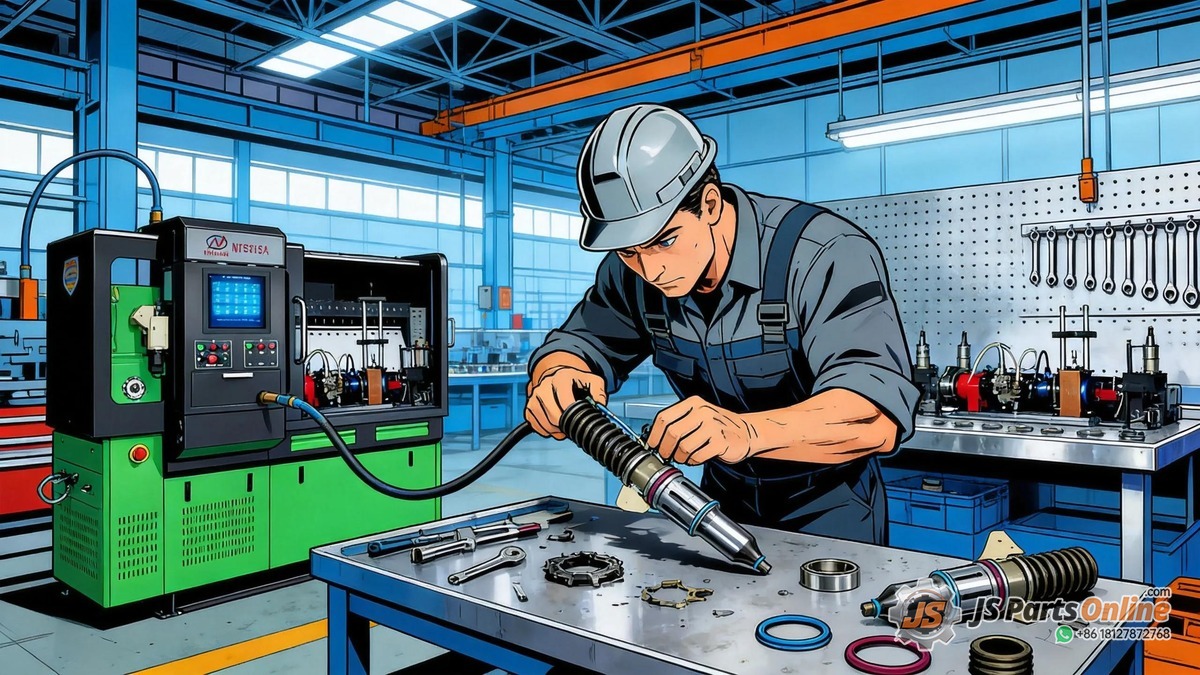
When a diesel engine begins blowing colored smoke from the exhaust stack, experienced mechanics know the smoke itself is a diagnostic tool. The color, density, timing, and conditions under which smoke appears can pinpoint problems ranging from injector failure to turbocharger seal leakage — often before a scan tool even connects. But misreading smoke signals leads to unnecessary parts replacement and wasted diagnostic hours.
In this guide, we break down the three primary diesel exhaust smoke colors — white, black, and blue — and map each to its most likely fuel injector-related root causes. We also cover the diagnostic flow for isolating injector problems from other combustion system faults that can produce similar symptoms.
Diesel Exhaust Smoke Color Quick-Reference
| Smoke Color | Primary Cause | Most Common Injector Fault | Smell | Typical Engine State |
|---|---|---|---|---|
| White | Unburned fuel (cold cylinder) | Low compression / injector spray failure | Raw diesel / acrid | Cold start, idle, low load |
| Black | Over-fueling / incomplete combustion | Stuck-open injector / worn nozzle | Sooty / rich fuel | Acceleration, heavy load |
| Blue | Engine oil burning | Injector O-ring / seal failure (oil into cylinder) | Burning oil | Startup, deceleration, idle |
| Gray-White | Atomized unburned fuel (hot engine) | Injector dribbling / late injection timing | Acrid diesel | Warm idle, light cruise |
| White-Blue Mix | Coolant + oil (head gasket) | Not injector-related (gasket/liner) | Sweet + oily | All conditions, worsens with load |
White Smoke: The Cold-Start Warning
White smoke at startup is the most common — and most misunderstood — exhaust signal in diesel engines. When you see white smoke on a cold morning, the immediate assumption is often “glow plug problem” or “bad injector.” The reality is more nuanced.
Injector-Related White Smoke Causes
| Symptom Pattern | Injector Cause | Non-Injector Cause | Key Test |
|---|---|---|---|
| White smoke cold start only, clears after 2-3 minutes | Worn injector nozzle (poor atomization when cold) | Weak glow plugs / grid heater | Cylinder cutout test when warm |
| White smoke at idle, all temperatures | Injector stuck partially open / leaking | Low compression (rings/valves) | Compression test + injector leak-off test |
| White smoke + rough idle + fuel in oil | Injector body crack / seal failure | Cylinder wash-down from over-fueling | Oil analysis + bore scope inspection |
| White smoke under acceleration | Injector timing retarded (mechanical engines) | Turbocharger under-boost | Injection timing verification + boost test |
| White smoke + coolant loss | Rarely injector-related | Head gasket / EGR cooler / liner O-ring | Coolant pressure test + combustion gas test |
For HEUI-equipped CAT engines (3406E, C7, C9, C12, C15), white smoke at cold start is frequently traced to low injection control pressure (ICP) rather than the injector itself. Before condemning a set of CAT fuel injectors, verify ICP actual vs. desired values during cranking. A worn high-pressure oil pump or leaking ICP sensor O-ring can mimic injector failure symptoms identically.
Black Smoke: Over-Fueling and the Injector Connection
Black smoke is unburned carbon — fuel that entered the cylinder but didn’t find enough oxygen to complete combustion. While turbocharger, air filter, and EGR system faults can all cause black smoke, fuel injector problems are the leading cause in high-hour engines.
Injector-Related Black Smoke Mechanisms
| Failure Mode | Mechanism | Smoke Pattern | Diagnostic Test | Typical Mileage/Hours |
|---|---|---|---|---|
| Nozzle hole erosion | Enlarged orifices deliver excess fuel | Progressive, worsens over weeks | Injector flow bench test | 8,000–12,000 hrs |
| Stuck-open injector | Needle fails to seat, continuous dribble | Sudden onset, heavy black smoke | Cylinder cutout test | Any (contamination event) |
| Incorrect IQA code | ECU commands wrong fuel quantity | Immediately after injector replacement | Verify IQA trim codes programmed | Post-service only |
| Sac volume carbon build-up | Post-injection dribble from carbon in nozzle sac | Light haze at idle, heavy under load | Injector disassembly / inspection | 5,000–8,000 hrs |
| Spring fatigue | Nozzle spring weakens, opening pressure drops | Gradual, RPM-dependent | Pop test / opening pressure test | 10,000–15,000 hrs |
A critical diagnostic distinction: black smoke that appears only under load and clears at idle is more often an air restriction problem (turbo, intercooler, air filter) than an injector problem. Black smoke that persists at all engine speeds, especially at idle, points strongly toward a fuel system fault — and injectors are the prime suspects.
Blue Smoke: When Oil Enters the Combustion Chamber
Blue smoke means oil is burning, and the injector connection is often overlooked. While valve stem seals, piston rings, and turbocharger seals are the usual suspects, injectors play a role in two specific scenarios that mechanics frequently miss.
Injector-Related Blue Smoke Pathways
| Pathway | Engine Types Affected | Symptoms | Detection Method |
|---|---|---|---|
| Injector O-ring / seal failure | HEUI engines (CAT C7, C9, 3126, 3406E) | Blue smoke + fuel dilution in engine oil | Oil analysis showing fuel > 5% |
| Injector bore wear | All diesel engines > 10,000 hrs | Blue smoke + external oil leak around injector body | Visual inspection + bore gauge measurement |
| Copper washer / crush seal failure | Common rail engines | Blue smoke + combustion gas in fuel return | Bubble test on return line |
| Injector sleeve / cup crack (HEUI) | CAT HEUI engines | Blue smoke + coolant in oil (if crack extends to water jacket) | Coolant pressure test + injector bore scope |
On CAT HEUI engines, the injector sits in a bore that is surrounded by high-pressure engine oil (used for injection actuation). A failed O-ring on the injector body allows this oil to enter the combustion chamber directly through the injector bore — producing blue smoke that is unmistakably injector-related, even though the injector itself may still be functioning mechanically.
Systematic Smoke Diagnosis: The 5-Minute Protocol
Before reaching for a scan tool or injector puller, run this five-minute protocol to narrow the diagnostic field:
| Step | Action | Observation | Narrows To |
|---|---|---|---|
| 1 | Note smoke color AND smell (from a safe distance) | White/black/blue + acrid/sweet/oily | Fuel vs oil vs coolant source |
| 2 | Record when smoke appears: cold start / warm idle / acceleration / deceleration / steady cruise | Pattern drives diagnostic tree | Injector mechanical vs ECU vs air system |
| 3 | Perform cylinder cutout test (electronically via scan tool or manually on mechanical engines) | Smoke changes on specific cylinder cut | Single-cylinder vs multi-cylinder fault |
| 4 | Check fuel return flow / leak-off volume per injector | One injector returns significantly more fuel | Internal injector leakage / worn nozzle |
| 5 | Check oil level and condition (smell for diesel, look for milky appearance) | Oil overfull / diesel smell / milky | Injector seal failure / head gasket |
If the cutout test identifies a single cylinder contributing most of the smoke, and the leak-off test confirms elevated return flow from that cylinder’s injector, the diagnostic path is clear: replace or rebuild the offending injector. If all cylinders contribute equally, look upstream — air system, fuel quality, injection timing, or ECU programming.
Engine-Specific Smoke Patterns
| Engine Platform | Most Common Smoke Type | Typical Root Cause | First Diagnostic Step |
|---|---|---|---|
| CAT 3406E (HEUI) | White smoke cold start | Low ICP / worn injector plunger | ICP actual vs desired comparison |
| CAT C7 / C9 (HEUI) | Blue smoke at idle | Injector O-ring degradation | Oil analysis + injector bore inspection |
| Cummins ISX (Common Rail) | Black smoke under load | Injector nozzle erosion / over-fueling | Injector performance test on bench |
| Detroit Diesel Series 60 | White haze at cruise | EUI injector wear / timing drift | Run overhead + injector height adjustment |
| CAT 3508/3512/3516 | Black smoke + power loss | Stuck injector plunger (mechanical EUI) | Cylinder exhaust temperature scan |
| Duramax LB7/LLY | White smoke + fuel in oil | Injector body crack (known issue) | Oil level + fuel dilution test |
Key Takeaways
- White smoke that clears after warm-up rarely means injector replacement — check glow plugs, grid heaters, and ICP first.
- Black smoke at all engine speeds points to injector over-fueling; black smoke only under load points to air system restrictions.
- Blue smoke on HEUI engines should trigger immediate injector O-ring inspection — this is a known failure mode that can lead to runaway if left unchecked.
- Cylinder cutout + leak-off test is the gold-standard two-test combination for isolating injector-related smoke problems.
- Smoke diagnosis is a system-level exercise — always rule out air, EGR, turbo, and compression issues before condemning injectors.
For quality replacement injectors across all engine platforms, browse our complete CAT diesel injector catalog or contact our support team for cross-reference assistance.



JSPartsonline:
Focus on injectors for 12 years,We sell high-quality fuel injectors at competitive prices.
Copyright 2025 © YUN·X . All right reserved.
