
Common HEUI Injector Problems and Solutions: A Troubleshooting Guide
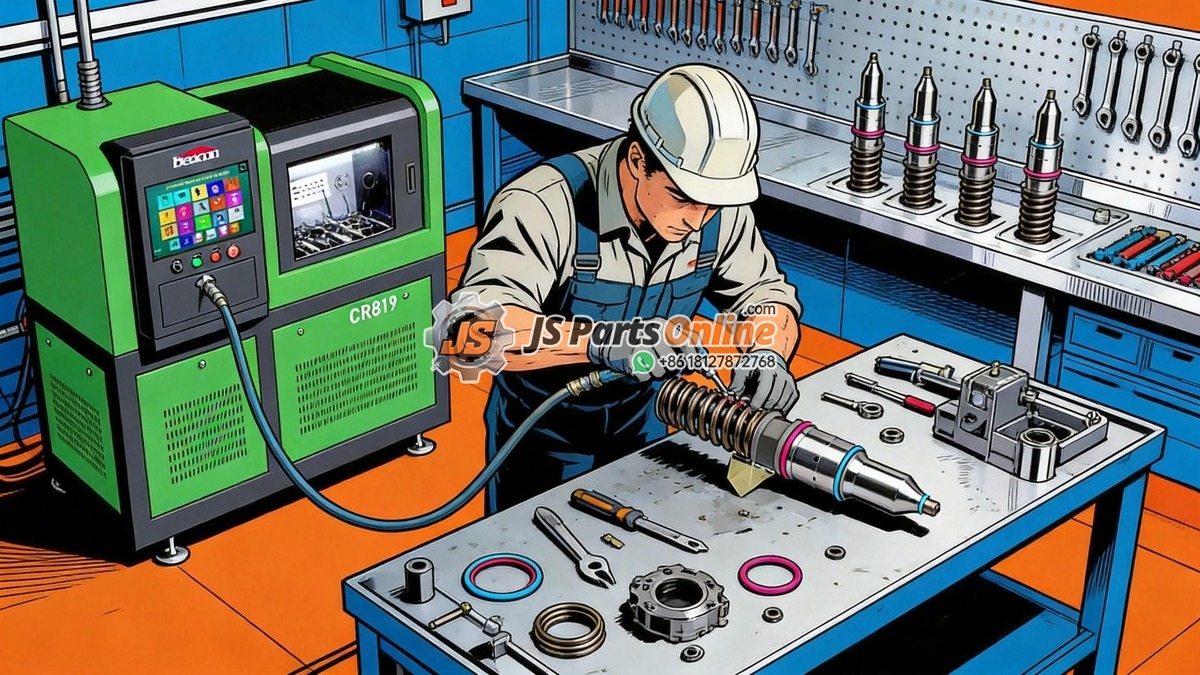
HEUI injectors power millions of Caterpillar, Navistar, and Ford diesel engines worldwide, but they come with a unique set of failure patterns that differ fundamentally from common rail and mechanical injector systems. If you have ever dealt with a CAT 3406E that starts hard after sitting, a C7 with cold-start misfire, or a 7.3L Power Stroke with a rough idle that comes and goes, you have met HEUI injector problems face to face. This guide walks through the seven most common HEUI injector failure modes, their root causes, diagnostic test procedures, and proven solutions.
1. What Makes HEUI Injectors Different
Before diving into problems, understanding what makes HEUI (Hydraulic Electronic Unit Injector) unique is essential for diagnosis. Unlike common rail systems that use a dedicated high-pressure fuel pump, HEUI uses engine oil pressurized to 450-3,000 psi as a hydraulic medium. An intensifier piston inside each injector multiplies this oil pressure at a 6:1 to 7:1 ratio to achieve injection pressures up to 21,000 psi at the nozzle tip. The injector solenoid, controlled by the Injector Driver Module (IDM), opens a poppet valve that admits high-pressure oil above the intensifier piston, which then drives the plunger down to pressurize and inject fuel.
This oil-driven design delivers excellent cold-start performance and precise injection control, but it also means that oil quality, oil pressure, and the health of the high-pressure oil pump directly determine injector performance. A fuel-only issue in a common rail engine becomes a combined fuel-and-oil issue in a HEUI engine, making diagnosis more complex.
2. Problem 1: Injector Stiction
Stiction, a portmanteau of static and friction, is the number one HEUI injector complaint. It occurs when the intensifier piston inside the injector sticks or moves erratically due to oil varnish buildup, cold oil viscosity, or manufacturing tolerances. The result is delayed or missed injection events, particularly at idle and light load when oil pressure is lowest.
| Symptom | When It Occurs | Confirmation Test | Solution |
|---|---|---|---|
| Cold start misfire, clears when warm | Engine cold, ambient below 50 degrees F | Cylinder cutout test when cold vs. warm; misfiring cylinder changes | Oil change with synthetic 5W-40, injector cleaning additive |
| Rough idle that improves above 1,200 RPM | Idle after cold start | Monitor balance rates; erratic at idle, smooth at raised RPM | Hot oil flush, replace injectors if persistent above 3 percent balance variation |
| Random misfire, no consistent cylinder pattern | Intermittent, often after highway cruise then idle | Perform injector buzz test; listen for weak or delayed solenoid click | IDM relay and wiring check first; replace individual sticky injectors |
| White smoke at cold idle, clears after warm-up | Below 40 degrees F ambient | Glow plug and intake heater functional test; if OK, suspect stiction | Oil grade change to manufacturer cold-weather recommendation |
Prevention is far cheaper than replacement. Use high-quality diesel-rated synthetic oil, change oil strictly on schedule (no extending intervals on HEUI engines), and add a PIB-based injector cleaner every other oil change. For engines with known stiction issues, especially 6.0L Power Stroke and early C7 ACERT, switching from 15W-40 to synthetic 5W-40 often eliminates mild stiction entirely.
3. Problem 2: High-Pressure Oil Pump Wear
The high-pressure oil pump (HPOP) is the heart of the HEUI system. If the HPOP cannot generate and maintain adequate oil pressure, every injector suffers. HPOP wear is progressive and often goes undiagnosed until injectors are wrongly condemned.
| Parameter | Normal Value | Failing Value | Diagnostic Tool |
|---|---|---|---|
| ICP (Injection Control Pressure) at idle | 450 to 750 psi | Below 400 psi or above 800 psi | Scan tool, ICP sensor reading |
| ICP at wide-open throttle | 2,800 to 3,200 psi (varies by engine) | Below 2,000 psi under load | Scan tool, road test data log |
| IPR (Injection Pressure Regulator) duty cycle | 15 to 25 percent at hot idle | Above 35 percent at hot idle | Scan tool, IPR commanded percentage |
| HPOP pressure build time during cranking | Reaches 500 psi within 3 seconds | Above 7 seconds to reach 500 psi | Scan tool, crank log |
| ICP voltage at KOEO (Key On Engine Off) | 0.18 to 0.26 volts | Above 0.30 volts grounded or below 0.15 volts open | Multimeter at ICP sensor connector |
Before replacing any HEUI injector, always verify HPOP performance. A worn HPOP that cannot maintain pressure at high demand will cause what appears to be multiple injector failure. Replace the HPOP if IPR duty cycle exceeds 35 percent at hot idle, if ICP cannot reach 500 psi within 5 seconds of cranking, or if ICP drops more than 300 psi during an injector buzz test.
4. Problem 3: Oil Aeration
Oil aeration, tiny air bubbles suspended in engine oil, is a silent killer of HEUI injectors. Because HEUI injectors use oil as a hydraulic medium, any compressibility in that medium (from air bubbles) causes delayed injection timing, reduced injection pressure, and inconsistent fuel delivery. Oil aeration produces symptoms virtually identical to injector failure but is a system-level issue.
| Cause | How It Aerates Oil | Symptoms | Fix |
|---|---|---|---|
| Overfilled crankcase | Crankshaft whips oil into foam | Erratic ICP readings, power loss at high RPM | Drain to correct level, verify dipstick calibration |
| Worn LPOP (low-pressure oil pump) | Insufficient oil supply to HPOP reservoir | ICP drops under sustained load, returns to normal after cooldown | Replace LPOP, verify pickup tube O-ring seal |
| Leaking HPOP reservoir check valve | Oil drains back, HPOP starts dry | Extended crank time, ICP slow to build on startup | Replace HPOP reservoir gasket and check valve |
| IPR O-ring failure | Air enters through degraded IPR O-rings | Intermittent ICP fluctuations, hard hot start | Replace IPR and O-ring kit, clean IPR screen |
| Incorrect oil viscosity | Too thin oil cavitates in HPOP | ICP drops as oil temperature rises | Switch to correct viscosity per OEM specification |
The definitive test for oil aeration is to run the engine at operating temperature, monitor ICP desired vs. actual, and perform a series of snap-throttle events. If actual ICP lags desired ICP by more than 200 psi during throttle snaps, and ICP recovers slowly afterward, oil aeration is likely. An oil sample sent for foam tendency testing confirms the diagnosis.
5. Problem 4: Injector Driver Module (IDM) Failure
The IDM is the electronic brain that controls HEUI injector firing. It steps up battery voltage to approximately 110 volts DC and sends precisely timed 110-volt pulses to each injector solenoid. IDM failures produce a wide range of symptoms, from single-cylinder misfire to complete no-start, and are frequently misdiagnosed as injector failure.
| Failure Mode | Typical Symptom | Diagnostic Code | Test |
|---|---|---|---|
| Complete IDM failure, no injectors fire | Cranks, no start, no smoke from exhaust | P1298 IDM failure, or no communication with IDM | Check IDM relay, power, and ground; buzz test returns completely dead |
| Single bank failure (left or right bank dead) | Runs on 3 or 4 cylinders, heavy misfire | P1293 or P1294, injector high side open bank 1 or 2 | Swap IDM connectors left to right; if misfire moves, IDM fault confirmed |
| Weak IDM output, low injection energy | Hard start, low power, excessive smoke | Often no code set; intermittent performance complaints | Scope injector waveform; peak voltage below 90 volts indicates weak IDM |
| Intermittent IDM shutdown from overheating | Engine dies when hot, restarts after cooldown | P1298 IDM failure, stored in history | Heat IDM with heat gun while monitoring; disconnect and inspect connector corrosion |
Always perform an injector buzz test before condemning injectors. A buzz test that produces all solenoid clicks at uniform volume points away from the IDM and toward mechanical injector issues. Uneven or missing clicks can be caused by IDM, wiring, or the injector solenoid itself. Disconnect the IDM and measure resistance at the injector harness connector: 0.5 to 5 ohms is normal for most HEUI injector solenoids. An open circuit or short to ground anywhere in the harness indicates a wiring or solenoid issue, not the IDM.
6. Problem 5: Injector O-Ring and Seal Failure
HEUI injectors rely on multiple O-rings and seals to separate high-pressure oil, low-pressure fuel, and combustion gases. When these seals fail, cross-contamination occurs. Oil enters the fuel system, fuel dilutes engine oil, or combustion gases pressurize the fuel return circuit.
| Failed Seal | Fluid Contamination | Symptom | Diagnostic Method |
|---|---|---|---|
| Upper O-ring (oil to fuel) | Engine oil in fuel tank | Dark fuel, fuel filters turn black quickly, injector knock | Inspect fuel filter element; black discoloration = oil in fuel |
| Lower O-ring (fuel to oil) | Fuel in engine oil | Oil level rising, oil smells of diesel, thin oil | Oil analysis showing fuel dilution above 2 percent; rising dipstick level |
| Injector copper washer / seal | Combustion gas into fuel return | Excessive fuel return flow, black fuel, aerated fuel | Measure fuel return flow per injector; return above 50 mL per minute on a single injector suspect |
| External O-ring (oil or fuel leak) | External oil or fuel leakage | Visible oil or fuel around injector body, oil in valley | Pressurize oil rail with shop air and listen for leaks; soap bubble test around injectors |
On 6.0L Power Stroke engines, failed injector O-rings are one of the most common causes of a no-start hot condition. The fix is replacing all upper and lower injector O-rings as a set, using only OEM-quality Viton O-rings, and torquing injector hold-down bolts precisely to specification. Over-torquing crushes the copper washer unevenly, while under-torquing allows combustion gas bypass.
7. Problem 6: Injector Solenoid Coil Failure
The injector solenoid converts the IDM’s 110-volt pulse into mechanical movement of the poppet valve. Solenoid failures present as either an open coil that does not fire at all, or a shorted coil that draws excessive current and may damage the IDM. On some engines, a single shorted injector solenoid can shut down the entire IDM through its internal protection circuit.
The first test is always resistance measurement at the injector connector. With the IDM disconnected, measure resistance across each injector solenoid pair. Typical values are 0.5 to 3.0 ohms, but always check the specific engine’s specification. A reading above 10 ohms indicates a high-resistance solenoid, often from internal corrosion. A short to ground or reading below 0.3 ohms indicates a shorted solenoid coil. When resistance testing is inconclusive, a dynamic injector solenoid waveform captured with an oscilloscope reveals the solenoid’s electrical health during actual firing.
8. Problem 7: Nozzle Wear and Coking
Like all diesel injectors, HEUI injectors suffer from nozzle wear, coking, and erosion over time. However, HEUI nozzle problems have a unique characteristic: because injection pressure depends on oil pressure and intensifier piston condition, nozzle problems are often masked by system-level issues. A worn nozzle on a HEUI injector may not produce typical streaming or dribbling patterns until the HPOP is also struggling to maintain pressure.
Symptoms include black smoke under load that worsens as oil temperature rises, gradually decreasing fuel economy over tens of thousands of miles, and positive balance rates (ECM adding fuel) on the affected cylinder. Cylinder cutout testing often shows a smaller RPM drop on the affected cylinder because it is receiving less usable fuel per injection event, not more. Replacing nozzles on HEUI injectors is possible but requires specialized tooling, and the labor cost often makes complete injector replacement the more economical choice.
9. Diagnostic Decision Tree for HEUI Complaints
Follow this logical diagnostic sequence before purchasing replacement injectors. The order matters because each step eliminates causes that produce identical symptoms to injector failure.
- Check for fault codes — IDM, ICP, and injector circuit codes point to electrical or system-level issues before mechanical injector problems.
- Verify engine oil condition and level — Old, aerated, overfilled, or incorrect-viscosity oil is the single most common cause of HEUI symptoms misdiagnosed as injector failure.
- Perform injector buzz test — All solenoids should click with uniform volume. Weak or missing clicks warrant electrical diagnosis before injector replacement.
- Monitor ICP desired vs. actual — If actual pressure falls more than 200 psi below desired under any condition, the HPOP or IPR is suspect, not the injectors.
- Check IPR duty cycle at hot idle — Above 35 percent indicates the HPOP is working at its limit to maintain pressure.
- Monitor cylinder balance rates — Engines with more than two cylinders showing balance rates above plus or minus 3.0 mm per stroke likely have a system-level problem, not individual injector failures.
- Cylinder cutout test — A single cylinder with drastically different RPM drop confirms injector-level diagnosis on that cylinder only. Multiple cylinders with similar minor drops point to HPOP or oil issues.
- Measure injector return flow — On engines with accessible return lines, a single injector returning more than 50 mL per minute indicates internal leakage.
10. Replacement Best Practices for HEUI Injectors
| Task | Why It Matters | Consequences of Skipping |
|---|---|---|
| Change engine oil and filter before injector replacement | Eliminates contaminated oil as a variable; fresh oil protects new injectors | Debris or aerated oil damages new injectors within first hours of operation |
| Clean injector bores thoroughly | Carbon and debris in the bore damage new O-rings during installation | Immediate O-ring failure, oil in fuel, fuel in oil |
| Replace all O-rings and copper washers | New injectors require new sealing surfaces; old seals are deformed | Leakage, contamination, potential catastrophic injector bore damage |
| Torque hold-down bolts to specification | Precise clamping force is required for proper copper washer crush and gas seal | Combustion gas blow-by, injector movement, bore damage |
| Prime oil system before starting | Prevents dry HPOP and injector startup, which causes immediate wear | Extended crank time, HPOP cavitation, injector intensifier scoring |
| Program injector trim codes (if applicable) | ECM uses trim codes to optimize per-cylinder fuel delivery | Unnecessary balance rate compensation, reduced fuel economy |
| Road test and recheck balance rates after 50 miles | New injectors settle differently; trim codes may need adjustment | Unresolved balance issues discovered late, after full installation labor is complete |
Conclusion
HEUI injector problems are rarely just injector problems. The oil system, high-pressure oil pump, IDM, and injectors form a tightly integrated system where a problem in any component produces symptoms in the injectors. Following the diagnostic sequence outlined above, starting with oil condition and HPOP performance and working systematically toward individual injector diagnosis, will save thousands of dollars in unnecessary injector replacements and eliminate the frustration of replacing injectors only to have the same symptoms return.
For OEM-quality replacement HEUI injectors for Caterpillar engines including 3406E, 3408E, 3412E, C7, C9, C10, C12, C13, C15, and C18, browse our complete CAT HEUI injector catalog. All injectors are flow-tested, spray-pattern verified, and come with installation O-ring kits. If you need help diagnosing a HEUI injector problem, contact our technical support team.
Related products




Related Posts
-
1

-
2

-
3

-
4

-
5

-
6



JSPartsonline:
Focus on injectors for 12 years,We sell high-quality fuel injectors at competitive prices.
Copyright 2025 © YUN·X . All right reserved.
