
OEM vs Aftermarket Diesel Injectors: Complete Buyer’s Guide for 2026
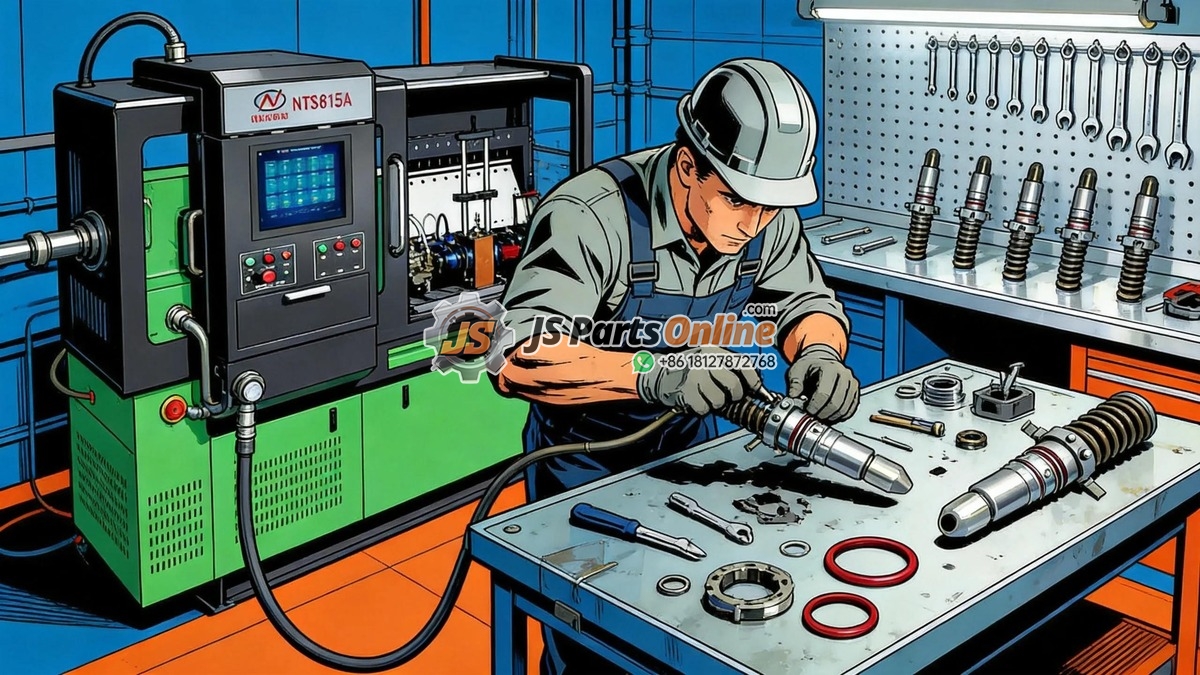
When a diesel engine needs new fuel injectors, the first question is almost always the same: should I buy OEM or aftermarket? The answer depends on your budget, your engine’s age and value, your expected remaining service life, and your tolerance for risk. This guide provides an objective, data-driven comparison of OEM, OEM-quality aftermarket, and budget aftermarket diesel injectors to help you make the right decision for your specific situation.
1. Understanding the Quality Tiers
| Tier | Examples | Price (vs. OEM) | Quality Standard | Best For |
|---|---|---|---|---|
| Tier 1: OEM New | CAT Genuine (223-5327, 194-5083), Cummins Recon, Detroit Genuine | 100% (baseline) | Factory-new, full OEM warranty, latest design revisions | New or low-hour engines; warranty requirements; critical applications where downtime is unacceptable |
| Tier 2: OEM Remanufactured | CAT Reman (10R-1256, 20R-0851), Cummins ReCon | 55-70% of OEM new | OEM facility rebuild to new specifications; same warranty as new; includes design updates | Mid-life engines; fleet maintenance programs; excellent value for engines with 5,000+ hours remaining |
| Tier 3: OEM-Quality Aftermarket | Quality aftermarket brands with documented testing; OEM-spec components | 40-55% of OEM new | New or remanufactured to OEM specifications; documented flow testing; 12-24 month warranty | High-hour engines; budget-conscious operations; non-critical applications |
| Tier 4: Budget Aftermarket | Unbranded or generic injectors; lowest-price online sellers | 20-35% of OEM new | Variable quality; may not be flow-tested; short or no warranty; unknown component sourcing | Emergency repairs only when OEM unavailable; engines near end of life |
2. Price Comparison: What You Actually Pay
| Option | Per Injector | Set of 6 | Installation Labor | Total Cost | Warranty |
|---|---|---|---|---|---|
| CAT OEM New (e.g., 223-5327) | $550-$850 | $3,300-$5,100 | $800-$1,500 | $4,100-$6,600 | 12 months / unlimited hours |
| CAT Reman (e.g., 10R-1256) | $350-$500 | $2,100-$3,000 | $800-$1,500 | $2,900-$4,500 | 12 months / unlimited hours (same as new) |
| OEM-Quality Aftermarket New | $250-$400 | $1,500-$2,400 | $800-$1,500 | $2,300-$3,900 | 12-24 months |
| OEM-Quality Aftermarket Reman | $180-$300 | $1,080-$1,800 | $800-$1,500 | $1,880-$3,300 | 6-12 months |
| Budget Aftermarket | $100-$200 | $600-$1,200 | $800-$1,500 | $1,400-$2,700 | 30-90 days or none |
The price gap between OEM new and OEM-quality aftermarket is $1,000-$2,700 for a six-cylinder set. Over the expected service life of 10,000 to 15,000 hours for a properly maintained injector, this premium works out to approximately $0.07-$0.27 per operating hour. For most commercial operators, the decision comes down to whether the OEM premium is justified by reduced risk or extended service life.
3. What Actually Makes a Quality Aftermarket Injector
Not all aftermarket injectors are created equal. A quality aftermarket injector should meet these criteria:
- New OEM-specification nozzles: The nozzle is the most critical wear component. Quality aftermarket injectors use new nozzles manufactured to the same specifications (hole count, diameter, spray angle, sac volume) as the OEM nozzle. Reusing old nozzles or using generic nozzles is a hallmark of budget-tier injectors.
- Individual flow testing and documentation: Every injector should be tested on an injector test bench at multiple operating points and come with a printed test report showing flow rates, return flow, and response times. Without this documentation, you have no evidence the injector meets specifications.
- Flow-matched sets: For multi-cylinder engines, the six or eight injectors in a set should be flow-matched to within 1-2% of each other across the full operating range. The test report should show the matching data.
- Proper calibration data: The injector must come with the correct trim code, IMA code, or calibration file for your specific engine. Without this, the ECM cannot compensate for injector-to-injector manufacturing variations.
- New seals, O-rings, and installation hardware: Every injector should include a complete installation kit with new copper sealing washers, O-rings, and hold-down bolts where applicable. Reusing old seals is a leading cause of premature injector failure.
4. When OEM Makes Clear Financial Sense
There are specific situations where OEM injectors are the clearly correct choice:
- Engines under warranty: Installing non-OEM injectors may void the remaining engine warranty. The savings are not worth the warranty risk.
- Low-hour engines (under 5,000 hours): The engine has 10,000-20,000 hours of service life remaining. The small per-hour premium for OEM is negligible over this timeframe.
- Critical applications: Emergency generators, fire pumps, marine propulsion, and other applications where injector failure threatens life safety or causes unacceptable business interruption. The cost of downtime dwarfs any injector cost difference.
- Emissions-certified engines (Tier 4 Final, Stage V): These engines are calibrated for specific injector flow characteristics. Non-OEM injectors that deviate from these characteristics can cause emissions compliance issues and DPF regen problems.
- Latest-generation engines (CAT C9.3, C13, C18 ACERT): Piezo-electric and advanced solenoid injectors have extremely tight operating windows. Aftermarket options for these newest injector designs may have limited field validation.
5. When Quality Aftermarket Makes Clear Financial Sense
Conversely, there are situations where OEM-quality aftermarket injectors are the smarter financial decision:
- High-hour engines (over 15,000 hours): The engine’s remaining service life may not justify the full OEM premium. Quality aftermarket injectors can provide 10,000+ hours of service at 40-55% of the OEM new price.
- Pre-emissions engines (pre-2007): These mechanically simpler engines are more tolerant of injector-to-injector variation. The calibration precision of OEM injectors is less critical.
- Fleet maintenance programs: When replacing injectors across a fleet of 10, 20, or 50 trucks, the savings from OEM-quality aftermarket add up to tens of thousands of dollars per maintenance cycle.
- Owner-operator trucks: The individual owner-operator bears the full cost of the injector set. Saving $1,500-$2,500 on a set of six injectors is meaningful when the engine already has 800,000 miles on it.
- Secondary or backup equipment: Engines in backup generators, seasonal agricultural equipment, or low-utilization machines do not need the full OEM premium.
6. Red Flags for Budget Aftermarket Injectors
| Red Flag | What It Means | Risk |
|---|---|---|
| Price below 30% of OEM | Corners have been cut somewhere—likely in component quality or testing | High probability of premature failure; may damage engine if injector over-fuels |
| No flow test report provided | Injector was not tested on a bench; installed as-is with unknown performance | Cylinder imbalance; fuel dilution; potential catastrophic failure from stuck-open injector |
| “Fits multiple engine models” without serial number verification | One-size-fits-all injector that may not have the correct calibration for any specific engine | Incorrect fuel delivery; poor performance; emissions issues |
| No warranty or less than 90 days | Supplier does not stand behind their product | No recourse if injector fails immediately after installation |
| Unbranded or unknown brand with no company history | May be a shell company selling imported injectors of unknown provenance | No accountability; no technical support; safety risk if injector fails catastrophically |
| Reused nozzles or visible wear on injector body | Injector was cleaned but not rebuilt; wear components not replaced | Service life measured in hundreds of hours, not thousands |
7. The Warranty Factor
Warranty coverage is a critical differentiator between quality tiers:
- OEM new and reman: 12 months, unlimited hours, honored at any authorized dealer or service center. Parts and labor covered. The OEM warranty has the least friction in practice because the dealer network is ubiquitous.
- OEM-quality aftermarket: 12-24 months typically, but read the fine print. Some warranties cover parts only, not labor. Others prorate coverage based on hours of use. A 24-month warranty that requires you to ship the failed injector back at your expense and wait 2-3 weeks for analysis is not equivalent to a CAT dealer swapping the injector same-day.
- Budget aftermarket: 30-90 days or no warranty. Even if a warranty is stated, enforcing it may be impractical if the seller is an online marketplace with no physical presence.
When comparing prices, factor in the value of warranty coverage. A CAT Reman injector at $400 with a 12-month full warranty may actually be cheaper than an aftermarket injector at $280 with a 3-month parts-only warranty if you factor in the probability and cost of a failure during the first year.
Conclusion
There is no universally correct answer to the OEM vs. aftermarket question—only the right answer for your specific engine, application, and budget. OEM injectors are the lowest-risk option and the clear choice for low-hour engines, critical applications, and warranty-protected equipment. OEM-quality aftermarket injectors from reputable suppliers offer an excellent value proposition for high-hour engines and budget-conscious operations, provided they meet the five criteria of quality outlined in this guide. Budget aftermarket injectors should be approached with extreme caution and reserved for emergency situations where no other option is available.
Browse our selection of OEM-quality CAT fuel injectors with documented flow testing, matched sets, and full warranty coverage. Every injector ships with a printed test report. Not sure which tier is right for your engine? Contact our technical sales team for an honest, no-pressure recommendation based on your engine’s hours, application, and budget.
Related products





Related Posts
-
1

-
2

-
3

-
4

-
5

-
6


JSPartsonline:
Focus on injectors for 12 years,We sell high-quality fuel injectors at competitive prices.
Copyright 2025 © YUN·X . All right reserved.
