
Diesel Fuel Injector Types: A Complete Comparison Guide
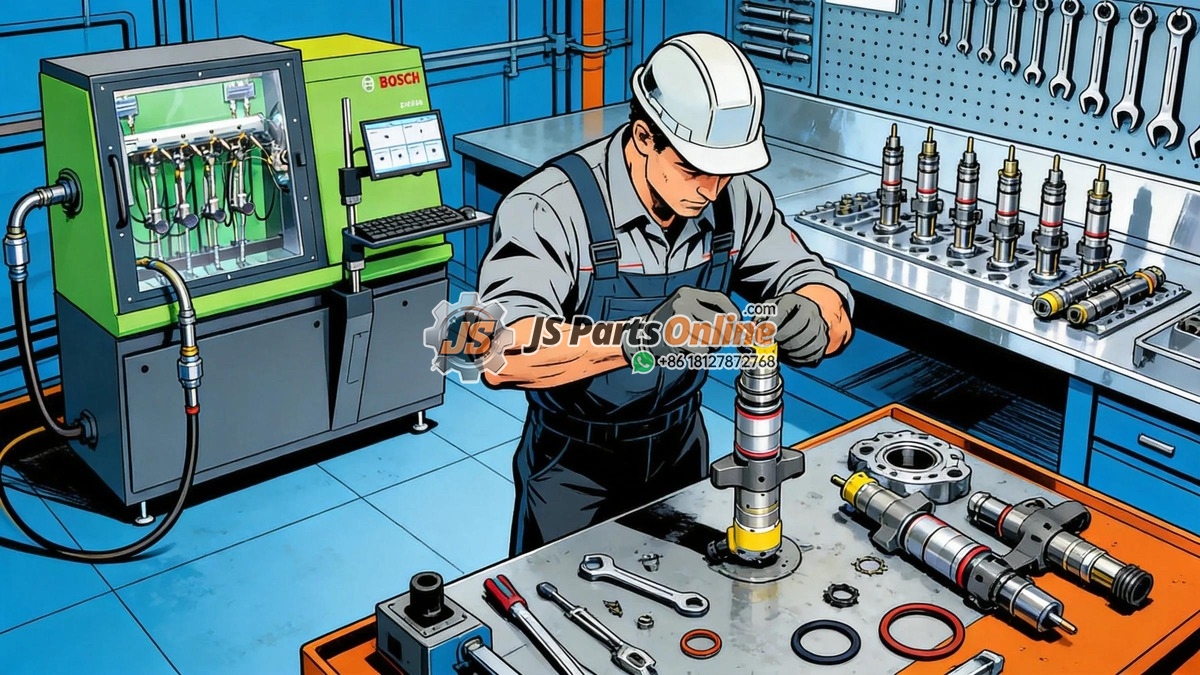
When it comes to diesel engine performance, the fuel injector is the single most critical component. But not all diesel injectors are created equal — in fact, there are several fundamentally different types, each with its own operating principles, advantages, and ideal applications. Whether you’re maintaining a Caterpillar 3406E, a Cummins ISX, or a Detroit Diesel Series 60, understanding which injector technology your engine uses is essential for proper diagnostics, maintenance, and replacement decisions.
In this guide, we break down the four major diesel fuel injector types — HEUI, MEUI, common rail, and traditional mechanical injectors — with detailed comparison tables, performance characteristics, and practical guidance to help you choose the right replacement for your engine.
1. HEUI Injectors — Hydraulic Electronic Unit Injection
HEUI (Hydraulic Electronic Unit Injector) is Caterpillar’s proprietary injection system, co-developed with Navistar in the early 1990s. Unlike conventional systems that rely solely on a camshaft-driven plunger, HEUI uses high-pressure engine oil — typically 450 to 3,000 psi — to amplify injection pressure via an intensifier piston inside the injector body. The result is injection pressures up to 21,000 psi at the nozzle tip, independent of engine RPM.
You’ll find HEUI injectors on CAT 3406E, 3408E, 3412E, C7, C9, C10, C12, C13, C15, and C18 engines, as well as Navistar DT466E and T444E (7.3L Power Stroke) applications. The system is renowned for its cold-start capability and precise injection control, but it’s also sensitive to oil quality — dirty or aerated oil can cause injector stiction, rough idle, and hard-start conditions.
2. MEUI Injectors — Mechanical Electronic Unit Injection
MEUI (Mechanical Electronic Unit Injector), also known as EUI (Electronic Unit Injector), represents the next evolutionary step from HEUI. CAT introduced MEUI with the ACERT technology engines starting around 2004. Instead of using engine oil as a hydraulic medium, MEUI relies on a camshaft-driven rocker arm to mechanically generate injection pressure, while an electronic solenoid controls injection timing and duration.
This design eliminates the oil-related issues common to HEUI systems and achieves injection pressures exceeding 28,000 psi. MEUI injectors are found on CAT C7 ACERT, C9 ACERT, C13 ACERT, C15 ACERT, and C18 ACERT engines, as well as many Detroit Diesel DD13, DD15, and DD16 engines. The mechanical actuation provides robust reliability, though camshaft and rocker arm wear can affect performance over time.
3. Common Rail Injectors — High-Pressure Electronic Control
Common rail injection is the dominant technology in modern diesel engines across all manufacturers. A high-pressure pump — capable of generating up to 36,000 psi — feeds a shared fuel rail (the “common rail”) that supplies all injectors simultaneously. Each injector is electronically actuated via a piezoelectric or solenoid valve, allowing multiple injection events per combustion cycle (pilot, main, and post-injection).
You’ll find common rail injectors on virtually every modern diesel platform: Cummins ISX, ISB, and QSK series; Detroit Diesel DD13 through DD16; Volvo D11, D13, and D16; and late-model CAT engines with common rail conversion. Common rail systems deliver the cleanest emissions and quietest operation, but injectors are sensitive to fuel contamination and require precise ECU coding after replacement.
4. Mechanical Injectors — Traditional Cam-Driven Systems
Before electronic controls dominated the industry, mechanical injectors — driven purely by the engine camshaft and governor — were the standard. These injectors use a cam lobe to drive a plunger that pressurizes fuel, with injection timing and quantity controlled mechanically via the governor linkage. Injection pressures typically range from 1,500 to 5,000 psi.
Mechanical injectors are still found on older CAT engines like the 3406B and 3406C, older Cummins N14 and 855 series, and Detroit Diesel two-stroke engines (53, 71, and 92 Series). They’re prized for their simplicity and rebuildability — no electronics to fail — but they lack the precision and emissions control of modern electronic systems.
Injector Type Comparison Tables
| Feature | HEUI | MEUI / EUI | Common Rail | Mechanical |
|---|---|---|---|---|
| Actuation Method | Engine oil hydraulic pressure | Camshaft-driven rocker arm | Electronic solenoid / piezo | Camshaft-driven plunger |
| Max Injection Pressure | ~21,000 psi | ~28,000+ psi | ~36,000 psi | ~5,000 psi |
| Electronic Control | Yes (ECM + IDM) | Yes (ECM + unit pump) | Yes (ECM + rail pressure sensor) | No (mechanical governor) |
| Multiple Injection Events | Limited (split-shot) | Limited | Yes (pilot + main + post) | No |
| Injection Timing Control | Electronic, oil-pressure dependent | Electronic solenoid | Fully electronic | Mechanical (governor) |
| Injector Type | Common Engine Platforms | Typical Era |
|---|---|---|
| HEUI | CAT 3406E, 3412E, C7, C9, C10, C12, C15; Navistar DT466E, T444E (7.3L Power Stroke) | 1993 – 2004 |
| MEUI / EUI | CAT C7 ACERT, C9 ACERT, C13 ACERT, C15 ACERT, C18 ACERT; Detroit Diesel DD13, DD15, DD16 | 2004 – present |
| Common Rail | Cummins ISX, ISB, QSK; Detroit Diesel DD13-DD16; Volvo D11, D13, D16; modern CAT | 2007 – present |
| Mechanical | CAT 3406B, 3406C; Cummins N14, 855; Detroit Diesel 53/71/92 Series | Pre-1993 |
| Aspect | HEUI | MEUI / EUI | Common Rail | Mechanical |
|---|---|---|---|---|
| Oil Quality Sensitivity | High — dirty oil causes stiction | Moderate — cam lobe wear | Low — fuel-only system | Low — simple design |
| Fuel Contamination Risk | Moderate | Moderate | High — tight nozzle clearances | Moderate |
| Typical Service Life | 200,000 – 400,000 miles | 300,000 – 500,000 miles | 200,000 – 400,000 miles | Rebuild every 200,000-300,000 miles |
| Rebuildability | Yes — rebuild kits available | Yes — but requires calibration | Limited — often replace with reman | Yes — fully rebuildable |
| Common Failure Mode | Injector stiction, oil aeration | Cam wear, solenoid failure | Nozzle erosion, solenoid short | Plunger/scuffing wear, spring fatigue |
| Characteristic | HEUI | MEUI / EUI | Common Rail | Mechanical |
|---|---|---|---|---|
| Emissions Compliance | EPA Tier 1 / Euro I | EPA Tier 3 / Euro III-IV | EPA Tier 4 Final / Euro VI | Pre-emissions era |
| Fuel Efficiency | Good — split-shot capability | Very good — higher pressure | Excellent — multi-event injection | Fair — fixed timing |
| Noise Level | Moderate | Moderate | Quiet — pilot injection softens combustion | Loud — classic diesel clatter |
| Cold Start Performance | Excellent — oil pressure builds quickly | Good — glow plug assisted | Good — ECU-controlled | Poor — ether assist often needed |
| Power Density | High for displacement | Very high | High | Moderate |
| Control Feature | HEUI | MEUI / EUI | Common Rail | Mechanical |
|---|---|---|---|---|
| Injection Timing Flexibility | Good — ECM mapped | Very good — fast solenoid | Excellent — independent per cylinder | None — fixed by cam profile |
| Rate Shaping | Boot-shaped (oil pressure ramp) | Square / ramp | Fully programmable | Fixed by cam lobe |
| Pilot Injection | Split-shot on some models | Available on later versions | Standard — 1-2 pilot events | Not available |
| Post Injection (DPF Regen) | Not supported | Available on Tier 3+ | Standard | Not available |
| Cylinder Cutout | ECM-controlled | ECM-controlled | ECM-controlled | Not available |
5. How to Identify Your Injector Type
Identifying which injector technology your engine uses is the first step toward ordering the correct replacement. Here’s a practical approach:
- Check the engine data plate — the engine serial number (ESN) and arrangement number are the most reliable identifiers. Cross-reference with CAT SIS or the OEM parts catalog.
- Look at the injector body — HEUI injectors have a distinctive oil inlet port on the side; MEUI injectors have a larger top section housing the solenoid; common rail injectors are more compact with an electrical connector on top; mechanical injectors have a simple fuel inlet with no electronics.
- Check for an IDM (Injector Driver Module) — if your engine has a separate IDM box (often mounted on the engine), you’re dealing with a HEUI system. Common rail and MEUI systems use the main ECM directly.
- Count the cam lobes — MEUI engines have dedicated injector cam lobes on the camshaft, often with a distinctive rocker arm assembly per cylinder.
6. Choosing the Right Replacement Injector
When it’s time to replace your diesel fuel injectors, you have three sourcing options: OEM new, OEM remanufactured, and aftermarket. Each has its trade-offs:
| Option | Price Range | Quality | Warranty | Best For |
|---|---|---|---|---|
| OEM New (CAT, Cummins, Detroit) | $$$ — Highest | Factory-spec, zero-hour | 12-24 months | Critical applications, warranty repairs |
| OEM Remanufactured | $$ — 40-60% of new price | Factory-rebuilt to spec | 12 months typical | Budget-conscious fleets, older engines |
| Quality Aftermarket (OEM-spec) | $ — 30-50% of new price | Built to OEM specs, new components | 12-18 months | Cost-sensitive replacements, out-of-warranty engines |
| Budget Aftermarket | $ — Lowest | Variable — quality risk | 6-12 months | Not recommended for heavy-duty applications |
For Caterpillar engines, OEM-quality CAT injectors are available for HEUI, MEUI, and common rail platforms. We also carry Bosch common rail injectors for Cummins and Volvo applications, and Denso HP3/HP4 injectors for popular Japanese and European diesel platforms.
7. Installation Considerations by Type
| Requirement | HEUI | MEUI / EUI | Common Rail | Mechanical |
|---|---|---|---|---|
| Injector Coding / Programming | Not required (trim code only) | Trim code calibration | Required — IMA/QR code input to ECU | Not applicable |
| Special Tools Needed | Injector bore brush, torque wrench | Injector height setting tool | High-pressure line torque wrench, diagnostic scanner | Injector timing tool, feeler gauge |
| Oil System Prep | Replace oil + filters | Not required | Not required | Not required |
| Fuel System Priming | Standard | Standard | Critical — air in rail = no start | Standard |
| Post-Installation Verification | IDM self-test, leak-off test | Cylinder cutout test | Rail pressure monitoring, injector balance rates | Engine run-in, leak check |
8. Common Injector Problems by Type
Each injector technology has its characteristic failure patterns. Knowing these helps with quicker diagnosis:
- HEUI: Injector stiction (internal plunger sticking due to oil varnish), oil aeration causing erratic injection, IDM failure, high-pressure oil pump wear, and injector O-ring deterioration.
- MEUI / EUI: Cam lobe and roller wear reducing injection pressure, solenoid coil open/short circuits, injector plunger scuffing from fuel contamination, and rocker arm adjustment drifting out of spec.
- Common Rail: Nozzle erosion from poor fuel quality or water contamination, solenoid or piezo actuator electrical failure, inlet metering valve sticking, injector back-leakage exceeding spec, and return flow issues causing rail pressure collapse.
- Mechanical: Plunger and barrel wear from contaminated fuel, delivery valve erosion, spring fatigue causing low pop pressure, carbon buildup on nozzle tip, and governor calibration drift affecting timing.
Conclusion
Understanding the differences between HEUI, MEUI, common rail, and mechanical injectors is essential for making informed maintenance and replacement decisions. HEUI remains a solid, rebuildable platform for millions of CAT engines still in service worldwide. MEUI offers an evolutionary step up with higher pressures and fewer oil-related issues. Common rail is the modern standard with unmatched precision and emissions performance. And mechanical injectors continue to serve in legacy engines where simplicity is paramount.
For quality replacement injectors across all four types — with a special focus on Caterpillar diesel fuel injectors — browse our complete product catalog. We offer OEM-spec new and remanufactured injectors with full warranty coverage and worldwide shipping. If you need help identifying the correct injector for your engine serial number, contact our technical support team for assistance.
Related products





Related Posts
-
1

-
2

-
3

-
4

-
5

-
6



JSPartsonline:
Focus on injectors for 12 years,We sell high-quality fuel injectors at competitive prices.
Copyright 2025 © YUN·X . All right reserved.
