
Diesel Fuel Injector Calibration and IQA Coding Guide
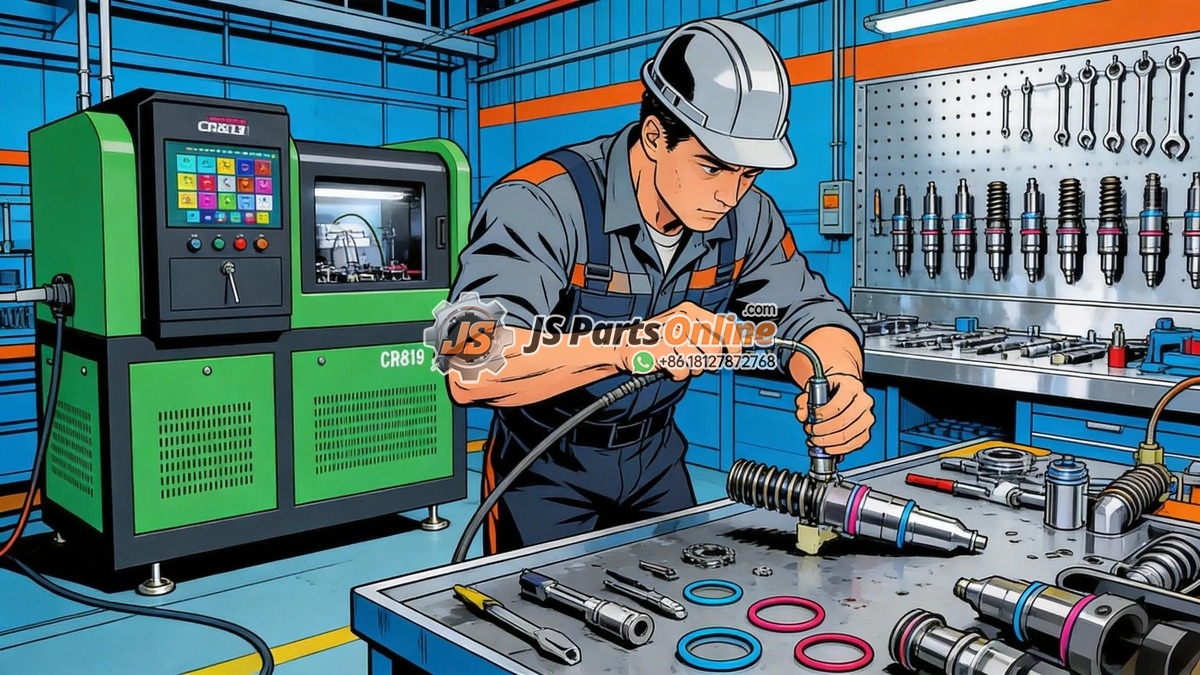
Modern diesel fuel injectors are not plug-and-play components. Every electronically-controlled injector leaves the factory with a unique calibration code — often called an IQA (Injector Quantity Adjustment) code, trim code, or calibration code — that tells the engine’s ECU exactly how that specific injector behaves. Skip the coding step after replacement, and you’re leaving power, fuel economy, and emissions compliance on the table. Get it wrong, and you risk cylinder imbalance, increased DPF regen frequency, and even piston damage from over-fueling.
In the image above, you can see the precision components that make modern diesel injection possible. The calibration process bridges the gap between mechanical precision and electronic control. This guide covers everything from understanding IQA codes to performing injector calibration on a test bench and programming codes into the ECU across major engine platforms including CAT, Cummins, Detroit Diesel, and Volvo.
What Are IQA Codes and Why Do They Matter?
IQA codes (also called trim codes, calibration codes, or injector adjustment codes) are alphanumeric strings — typically 7 to 30 characters — printed on each injector body. They represent the results of the factory flow test: how much fuel this specific injector delivers at various actuation durations and rail pressures, relative to the nominal specification.
| Manufacturer | Code Name | Typical Format | Characters | Stored In |
|---|---|---|---|---|
| Caterpillar | Injector Trim Code | XXXXXXXX-XX | 10-12 | ECM injector trim file |
| Cummins | IQA Code / Calibration Code | XXXX-XXX-XXXX | 13-20 | ECM calibration |
| Detroit Diesel | Injector Calibration Code (ICC) | XXX-XXXXX-XXX | 13-15 | MCM / ACM |
| Volvo / Mack | Injector Classification Code | XXXXX-X-XX | 9-12 | EMS calibration |
| Bosch (通用) | IMA / IQA Code | XXXX-XXX-XXXXXX | 16-20 | ECU EEPROM |
What Happens When IQA Codes Are Not Programmed
Without correct IQA coding, the ECU assumes every injector delivers the nominal fuel quantity. Reality is different — manufacturing tolerances mean two injectors with the same part number can differ by ±3-5% in delivered fuel quantity at the same pulse width. The ECU uses IQA codes to compensate for these differences, achieving cylinder-to-cylinder fuel balance within ±1%.
| Consequence | Mechanism | Severity | Detectable By |
|---|---|---|---|
| Cylinder imbalance | Unequal fuel delivery → uneven power strokes | Moderate | Rough idle, vibration at specific RPM |
| Increased fuel consumption | ECU enriches all cylinders to compensate for leanest | High | 3-8% higher fuel usage |
| Excessive DPF regeneration | Over-fueling cylinders produce more soot | High | Frequent active regens, shortened DPF life |
| Elevated exhaust temperature | Late/incomplete combustion from wrong timing trim | Critical | EGT gauge, turbo thermal stress |
| Piston / cylinder scoring | Severe over-fueling washes oil film, causes hot spots | Critical | Compression loss, blow-by, metallic oil |
| Emissions test failure | NOx and PM outside calibrated range | High | Opacity test, PEMS measurement |
Injector Test Bench Calibration Procedure
Before an injector can be assigned an IQA code, it must be tested and calibrated on a certified test bench. The industry standard for common rail injector testing is the CR819 and similar Hartridge/ZHENGHAO platforms.
| Test Point | Rail Pressure (bar) | Energizing Time (µs) | Target Delivery (mm³/stroke) | Acceptable Tolerance |
|---|---|---|---|---|
| VL (Very Low) | 250-300 | 300-500 | 1-5 | ±1.0 mm³ |
| LL (Low Load) | 400-600 | 400-600 | 10-20 | ±1.5 mm³ |
| MP (Mid Point) | 800-1000 | 600-900 | 50-80 | ±2.0 mm³ |
| FL (Full Load) | 1400-1600 | 1000-1400 | 100-180 | ±3.0 mm³ |
| VL Em. (Emission) | 200-350 | 250-350 | 0.5-2.5 | ±0.5 mm³ |
| Back-leakage | 1600 | 0 (no injection) | <25 mm³/min | Per injector spec |
Critical calibration fluid note: Always use ISO 4113 calibration fluid, not diesel fuel. Diesel fuel’s viscosity varies with temperature and batch, introducing measurement errors of 2-5%. Calibration fluid maintains constant viscosity (±0.02 cSt) across the test temperature range.
Programming IQA Codes: Step-by-Step by Engine Platform
Caterpillar (CAT ET)
- Connect CAT Electronic Technician (ET) to the diagnostic connector
- Navigate to “Service” → “Calibrations” → “Injector Trim Codes”
- Select the cylinder you’re programming (1-6, 1-8, etc.)
- Enter the trim code exactly as printed on the injector body — do not transpose characters
- Click “Program” and wait for the ECM confirmation message
- Repeat for all replaced injectors
- Perform an “Injector Trim Validation” test if available on your ET version
Cummins (INSITE)
- Connect Cummins INSITE to the diagnostic connector
- Navigate to “ECM Calibration” → “Injector Calibration”
- Select “Update IQA Codes” from the calibration menu
- Enter the IQA code for each cylinder position — note that Cummins codes must be entered in firing order sequence, not cylinder number sequence
- INSITE validates the checksum of each code before accepting — an invalid code will be rejected immediately
- After all codes are entered, perform a “Fuel System Functional Test” to verify balance rates
Detroit Diesel (DDDL / DiagnosticLink)
- Connect DiagnosticLink to the vehicle diagnostic port
- Navigate to “Actions” → “Programming” → “Injector Calibration”
- Select the MCM (Motor Control Module) or ACM (Aftertreatment Control Module) depending on engine series
- Enter the 13-15 character ICC for each cylinder
- DD13/DD15/DD16 engines require both MCM and ACM coding if both module-controlled injectors are present
- Execute “Reset Learned Data” after programming to clear fuel trim adaptations
Injector Calibration Codes vs Fuel Trim Values: Know the Difference
| Aspect | IQA / Trim Code | Fuel Trim Value |
|---|---|---|
| What it is | Factory-measured injector characteristic | ECU-learned adaptation over time |
| Source | Printed on injector, from test bench | Calculated by ECU from crankshaft acceleration |
| When updated | Only when injector is replaced | Continuously during engine operation |
| Where stored | ECU EEPROM (permanent until overwritten) | ECU RAM (lost on battery disconnect) |
| Range of correction | ±15% fuel quantity | ±5% fuel quantity |
| Must be reset after injector replacement? | Yes — enter new codes | Yes — clear learned adaptations |
Common IQA Coding Mistakes and How to Avoid Them
| Mistake | Consequence | Prevention |
|---|---|---|
| Entering code for wrong cylinder position | Incorrect fuel trim applied to wrong cylinder; imbalance doubles | Tag each injector with cylinder number before removing old ones |
| Transposing characters (e.g., “3B” → “B3”) | Invalid checksum or wrong trim factor applied | Photograph each code and read from photo, not memory |
| Using IQA code from different injector part number | Trim map doesn’t match injector flow characteristics | Verify part number matches before entering code |
| Not clearing learned fuel adaptations | Old trim values fight new IQA codes for 50-100 operating hours | Always “Reset Learned Data” or equivalent after coding |
| Coding remanufactured injector with original code | Rebuilt injector has different flow characteristic than original | Use the new IQA code supplied with the reman injector |
Test Bench Selection: CR819 vs Alternatives
| Test Bench Model | Max Pressure (bar) | Injector Types Supported | IQA Code Generation | Approx. Price Range |
|---|---|---|---|---|
| CR819 | 1,800 | Bosch, Denso, Delphi, Siemens CR | Yes — automatic | $25,000-40,000 |
| Hartridge CRi-Pro | 2,000 | CR + HEUI + MEUI | Yes — with Sabre software | $35,000-60,000 |
| ZHENGHAO CR-C | 1,800 | Bosch, Denso CR | Semi-automatic | $12,000-20,000 |
| King Test KT-CR300 | 1,600 | Bosch, Denso CR | Manual entry required | $8,000-15,000 |
| Bosch EPS 815 | 1,800 | Bosch CR + EUI/EUP | Yes — Bosch factory protocol | $50,000-80,000 |
For independent shops and fleet maintenance facilities, the CR819 test machine hits the sweet spot of capability versus cost. It covers all major common rail injector platforms and generates IQA codes automatically based on test results — eliminating manual transcription errors.
Post-Calibration Verification
After programming IQA codes, verification is not optional. Here are the three checks every technician should perform:
- Balance Rate Check: With the engine at operating temperature and steady idle, check injector balance rates via diagnostic software. All cylinders should read within ±2.0 mm³/stroke of zero. Any cylinder outside ±4.0 mm³ indicates a coding error or a defective injector.
- Return Flow Test: Measure injector back-leakage quantity over 2 minutes at idle. Compare against manufacturer specification. Excessive return flow means the injector’s control valve is bypassing — a mechanical issue that coding cannot fix.
- Road Test with Data Logging: Record rail pressure, injection quantity, and balance rates under full-load acceleration. Rail pressure should remain stable (±50 bar); injection quantity should track driver demand smoothly; balance rates should stay within ±3.0 mm³ across the load range.
Conclusion
IQA coding is the critical final step that transforms a mechanically-correct injector replacement into a properly tuned fuel system. The 10 minutes it takes to enter calibration codes pays back immediately in smoother idle, better throttle response, and lower fuel consumption. For technicians and fleet managers who want to do the job right, investing in a quality test bench like the CR819 and maintaining a disciplined coding procedure is non-negotiable. Browse our full range of diesel fuel injectors and pump plungers — every injector ships with its IQA code clearly labeled and ready for programming.
Related products


Related Posts
-
1

-
2

-
3

-
4

-
5

-
6



JSPartsonline:
Focus on injectors for 12 years,We sell high-quality fuel injectors at competitive prices.
Copyright 2025 © YUN·X . All right reserved.
