
Diesel Injector Duty Cycle Explained: How Operating Conditions Affect Injector Lifespan
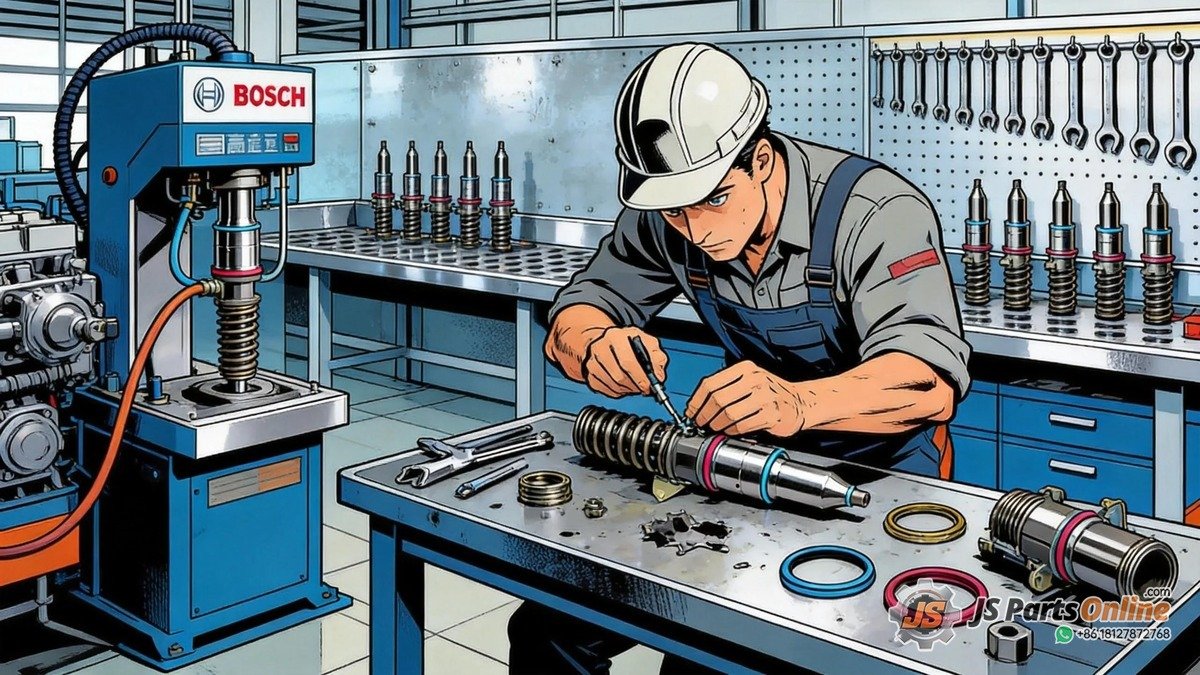
Ask any diesel technician how long a fuel injector “should” last, and you’ll get answers ranging from 5,000 to 20,000 hours. The truth is that injector lifespan is not a fixed number — it’s a direct function of duty cycle: the combination of load, RPM, fuel quality, operating temperature, and maintenance practices that define how hard each injector works over its service life.
This guide explains the relationship between operating conditions and injector longevity, quantifies the impact of different duty cycle profiles, and provides actionable strategies to maximize injector service life in real-world applications.
What Is Injector Duty Cycle?
Injector duty cycle is the percentage of available injection time that the injector is actively delivering fuel. In electronically controlled engines, this is literally the solenoid “on” time divided by the total cycle time. In mechanical engines, it’s the effective fueling duration relative to the maximum possible at a given RPM.
| Duty Class | Duty Cycle Range | Typical Applications | Injector Stress Profile | Expected Injector Life |
|---|---|---|---|---|
| Light Duty | 15–30% | Standby generators, backup pumps, seasonal farm equipment | Minimal thermal cycling; corrosion risk from inactivity | 10–20 years (time-limited, not hour-limited) |
| Moderate Duty | 30–50% | On-highway trucks, city buses, delivery vehicles, compact equipment | Moderate thermal cycling; soot accumulation in nozzle sac | 8,000–15,000 hrs (10–15 years typical) |
| Heavy Duty | 50–70% | Construction equipment, prime power generators, marine auxiliary, agricultural tractors | Significant thermal stress; nozzle erosion begins accelerating | 6,000–10,000 hrs (6–10 years typical) |
| Severe Duty | 70–85% | Mining haul trucks, offshore platform generators, locomotive engines, dredging pumps | High thermal + mechanical stress; continuous high-pressure operation | 4,000–8,000 hrs (3–6 years typical) |
| Extreme Duty | 85–100% | Diesel tractor pulling, marine racing, military combat vehicles | Maximum stress; injector considered a consumable component | 500–2,000 hrs (replaced as preventive maintenance) |
Key Operating Factors That Determine Injector Lifespan
| Factor | Mechanism of Wear | Impact Severity (1–10) | Typical Life Reduction | Mitigation Strategy |
|---|---|---|---|---|
| Fuel quality (sulfur, water, particulates) | Abrasive wear + corrosion + nozzle coking | 9 | 50–70% reduction with poor fuel | 2-micron absolute filtration, water separator, fuel testing |
| Sustained high load (>85% rated power) | Thermal stress on nozzle tip, spring fatigue | 8 | 30–50% reduction at sustained high load | Right-size engine for application; avoid continuous overload |
| Frequent thermal cycling (hot-cold-hot) | Differential expansion stress, condensation in fuel | 7 | 20–35% reduction | Engine pre-heating, cool-down idling, insulated fuel lines |
| Extended idle / low-load operation | Incomplete combustion, nozzle sac carbon build-up, cylinder wash-down | 6 | 15–25% reduction | High-idle kit, periodic load-bank exercise, avoid >15 min idle |
| Contaminated or degraded engine oil | Abrasive wear on HEUI intensifier piston / plunger | 6 | 15–30% reduction (HEUI engines only) | Strict oil change intervals, oil analysis program |
| Air filtration quality | Dust ingestion → abrasive wear in injector nozzle | 5 | 10–20% reduction | OEM-spec air filters, regular replacement, intake leak checks |
| Coolant system maintenance | Overheating → injector tip temperature exceeds design limit | 5 | 15–25% reduction with chronic overheating | Coolant testing, radiator cleaning, thermostat checks |
| IQA / trim code accuracy | Incorrect fueling → cylinder imbalance → uneven injector wear | 4 | 10–15% reduction if codes incorrect | Verify trim codes after every injector replacement |
Expected Service Life by Engine Platform
Based on aggregated field data from fleet operators, independent shops, and manufacturer service bulletins, here are the real-world injector life expectations for common diesel engine platforms under moderate to heavy duty operating conditions with good maintenance practices:
| Engine Platform | Injector Type | Typical Life (Good Maintenance) | Typical Life (Poor Maintenance) | Primary Life-Limiting Factor | Failure Mode Trend |
|---|---|---|---|---|---|
| CAT 3406E / C15 (HEUI) | HEUI | 10,000–14,000 hrs | 4,000–7,000 hrs | HEUI intensifier piston wear + plunger scuffing | Gradual; hard-start cold → misfire → no-start |
| CAT C7 / C9 (HEUI) | HEUI | 8,000–12,000 hrs | 3,500–6,000 hrs | Injector O-ring degradation → oil into fuel | Gradual; blue smoke → oil consumption → fuel dilution |
| CAT C13 (HEUI) | HEUI | 9,000–13,000 hrs | 4,000–7,000 hrs | Solenoid coil fatigue from under-valve-cover heat | Intermittent; electrical codes → hard-start → complete failure |
| CAT 3508/3512/3516 (EUI) | EUI / MEUI | 12,000–18,000 hrs | 6,000–10,000 hrs | Nozzle erosion from sustained high-load operation | Gradual; power loss → black smoke → exhaust temp spread |
| Cummins ISX (Common Rail) | Common Rail | 8,000–12,000 hrs | 3,000–6,000 hrs | Injector tip deposit build-up (coking) | Gradual; fuel consumption increase → misfire codes |
| Detroit Diesel DD15 | Common Rail (Amplified) | 10,000–15,000 hrs | 5,000–8,000 hrs | Amplifier piston wear in injector body | Gradual; power loss → fuel dilution → injector lock-up |
8 Strategies to Maximize Injector Service Life
| # | Strategy | Implementation | Expected Life Gain | Cost to Implement | ROI |
|---|---|---|---|---|---|
| 1 | Install 2-micron absolute fuel filtration | Secondary fuel filter upgrade (e.g., CAT Advanced High Efficiency) | +20–40% | $200–600 | Very High |
| 2 | Implement oil analysis program | Sample every 250 hrs; track wear metals, fuel dilution, soot | +10–20% | $20–50 per sample | High |
| 3 | Install engine pre-heater | Block heater or coolant heater for cold-climate operation | +10–15% (cold climates) | $300–1,500 | High (cold regions) |
| 4 | Right-size engine to application | Ensure engine operates at 60–80% of rated power, not 90%+ | +20–35% | Capital cost (new equipment spec) | Medium (retrofit impractical) |
| 5 | Eliminate extended idling | Install auto-shutdown timer; limit idle to 5 minutes | +10–15% | $100–300 (auto-shutdown) | High |
| 6 | Use premium diesel fuel additives | Cetane booster + lubricity additive + biocide (as needed) | +5–15% | $0.02–0.05 per gallon | Medium–High |
| 7 | Perform regular injector leak-off testing | Measure return flow quarterly; trend individual injector data | +5–10% | $0–100 (DIY) / $200–400 (shop) | High (prevents catastrophic failure) |
| 8 | Replace injectors as a matched set | When one injector fails, replace all to maintain cylinder balance | Prevents cascade failure | Higher up-front cost | Medium–High (avoids repeat labor) |
The Performance Degradation Curve
Most diesel injectors don’t fail suddenly — they degrade along a predictable curve that, if monitored, provides ample warning before catastrophic failure. Understanding where your injectors sit on this curve is the key to planned, budgeted replacement rather than emergency, premium-priced replacement.
| Stage | Hours (Typical) | Symptoms | Diagnostic Data | Recommended Action |
|---|---|---|---|---|
| Stage 0: New | 0–2,000 hrs | None; optimal performance | Fuel rate, return flow, and balance rates all within spec | Establish baseline data for future comparison |
| Stage 1: Break-in wear | 2,000–5,000 hrs | None visible | Return flow may increase 5–10% from baseline | Continue monitoring; no action needed |
| Stage 2: Detectable degradation | 5,000–8,000 hrs | Slightly rough cold idle, 2–5% fuel consumption increase | Balance rates exceeding ±3 mm³; return flow 15–25% above baseline | Schedule injector service at next major PM interval |
| Stage 3: Noticeable symptoms | 8,000–12,000 hrs | Hard cold start, blue/black smoke, 5–10% fuel increase, occasional misfire codes | Balance rates ±5–8 mm³; return flow 30–50% above baseline | Order replacement injectors; schedule replacement within 500 hrs |
| Stage 4: Imminent failure | 12,000–15,000 hrs | Continuous misfire, heavy smoke, power loss, fuel in oil, multiple DTCs | Balance rates > ±10 mm³; return flow > 50% above baseline | Replace immediately — risk of engine damage from fuel dilution |
| Stage 5: Catastrophic failure | Anytime (contamination, sudden event) | Engine won’t start, metal in fuel system, possible piston/cylinder damage | Zero or uncontrolled fuel delivery from failed injector | Full fuel system inspection + replacement of all injectors + fuel system flush |
Key Takeaways
- Injector lifespan is not a fixed number — it is the direct result of operating conditions within your control.
- The three biggest injector-life killers are: poor fuel quality, sustained overloading, and extended idling. Fix these three and you have addressed 70% of premature injector failures.
- Trend your data: return flow, balance rates, and fuel consumption tracked over time provide a crystal ball for injector health. Waiting for a check engine light means you have already waited too long.
- 2-micron fuel filtration is the single highest-ROI modification you can make to extend injector life — a $400 filter system that adds 3,000 hours to a $3,000 injector set is a 25× return on investment.
- When injectors enter Stage 3 degradation, schedule replacement proactively. The cost difference between planned replacement and emergency replacement (including downtime) typically exceeds $5,000 per incident.
For quality diesel fuel injectors built to handle the toughest duty cycles, visit our CAT fuel injector catalog. Every injector ships with complete test data and trim codes for confident installation. Contact our technical team for help selecting injectors matched to your specific duty cycle requirements.
Related products





Related Posts
-
1

-
2

-
3

-
4

-
5

-
6



JSPartsonline:
Focus on injectors for 12 years,We sell high-quality fuel injectors at competitive prices.
Copyright 2025 © YUN·X . All right reserved.
